
How to Secretly Get Ring Size Without Getting Caught
To secretly get ring size, borrow a ring they wear on the correct finger. Trace its inner diameter on paper, measure in millimeters, and use a conversion chart. Adjust the size up by a half size if you measured in cold morning air or if the ring came from their dominant hand. A jeweler can verify the size from the borrowed ring or your tracing. Direct finger measurement while they sleep is less reliable because knuckle size and temperature changes throw it off.
My grandmother’s heirloom box taught me that jewelry holds stories. The most beautiful story you can tell is a surprise that fits perfectly from the very first moment. But pulling off that surprise requires a little sleuthing, a touch of science, and knowing which corners you can’t cut.
This isn’t about guesswork. It’s about becoming a quiet detective, using the physical clues they leave behind every day. I’ll show you how to interpret those clues, adjust for the hidden variables, and walk into a jeweler with confidence.
Key Takeaways
- Steal size from an existing ring worn on the exact intended finger. This is 90% of the battle.
- Time of day and temperature change finger size by up to a full UK size. A ring that fits at 2 PM will be loose at 7 AM.
- The dominant hand is typically a half size larger than the non-dominant hand. Borrow from the left, plan for the right.
- Wide band rings (over 6mm) feel tighter. If you’re tracing one, you may need to size up from the measured diameter.
- Eternity bands and tension settings often cannot be resized. Your secret measurement must be perfect for these styles.
What’s the Most Foolproof Way to Steal a Ring Size?
Find a ring they already wear on the finger you’re targeting. The left ring finger for an engagement ring, the right middle finger for a birthday gift. This ring has already solved the knuckle problem and the comfort-fit equation. Your job is to steal its dimensions without a trace.
The single most accurate way to secretly determine ring size is to measure an existing ring that the person wears on the correct finger. This accounts for knuckle size, joint swelling, and personal comfort preference, which are impossible to gauge with a sleeping finger measurement.
The process feels like a heist. Your heart might pound as you try not to scratch the band. You need a piece of smooth, bleed-proof paper (I always use a Rhodia dotPad), a sharp pencil like a Palomino Blackwing, and a stainless steel ruler with etched millimeter markings, like the iGaging 6-inch model. Place the ring flat. Hold the pencil at a perfect 90-degree angle and trace the inside edge of the band. The lead makes a satisfying scratch.
Measure the diameter of this inner circle across its widest point. Use the millimeter side. Record the number. A 16.5mm diameter typically translates to a US size 6, but always use a current conversion chart. UK and US sizes differ by half increments.
TL;DR: Steal a ring from the correct finger, trace the inside diameter, measure in mm, and convert. It’s the only method that accounts for knuckle fit.
Can You Measure a Finger Directly Without Them Knowing?
Sometimes you can’t borrow a ring. The direct method is your fallback, but understand its flaws. The goal is to measure the finger’s base, where the ring will sit, not the wider knuckle. Doing this while someone is asleep is an exercise in gentle pressure and guesswork.
You need a non-stretchy material. A piece of dental floss or a narrow, flat strip of paper works. Avoid regular string or sewing thread, it stretches and gives a false small reading. Wrap the material around the base of the finger. Pull it snug enough to feel slight resistance but not tight. Mark where the end meets the material.
Lay the marked material flat against your ruler. Note the length in millimeters. This is the finger’s circumference. Divide this number by 3.14 (π) to get the diameter. Use the diameter with a size chart. The failure points are numerous. Did you measure at the very base? Was the finger warm or cold? A single millimeter of error in circumference throws the diameter off by a third of a size.
| Measurement Scenario | Likely Error | Consequence |
|---|---|---|
| Measuring a cold, morning finger | Underestimates by 0.5–1 size | Ring is painfully tight by afternoon |
| Using stretchy sewing thread | Underestimates circumference | Ring won’t fit over the knuckle |
| Measuring over the knuckle | Overestimates by 1–2 sizes | Ring spins constantly and feels loose |
| Right hand vs. left hand | 0.5 size difference | Ring is slightly loose or tight |
Common mistake: Measuring over the knuckle, this gives you the knuckle’s size, which will be too large for the ring’s final resting place. The ring will spin endlessly on the finger.
TL;DR: Direct measurement is a last resort. Use floss, measure at the finger’s base, and always add a half size to the chart result to compensate for cold and human error.
What Are the Critical Adjustments Everyone Forgets?
A raw measurement is just a number. To make it a wearable ring, you must adjust for biology and jewelry design. These three factors are the difference between a perfect surprise and a panicked trip back to the jeweler.
-
Hand Dominance & Time of Day. Fingers swell with heat, activity, and blood flow. For a right-handed person, the left ring finger is typically about half a size smaller. If you borrow a ring from their non-dominant hand for a dominant-hand gift, you must size up. Furthermore, fingers are smallest first thing in the morning and in cold, dry air. If you took your measurement under those conditions, you must add a half to a full size. The Gemological Institute of America confirms this in their official ring size measurement guide, noting temperature and even altitude change finger volume.
-
Band Width. A ring isn’t a single line. A wide band (over 6mm) covers more finger surface area and creates more internal friction. A size 6 in a delicate 2mm band will feel looser than a size 6 in a bold 8mm band. If the ring you want has a wide band, consider sizing up a quarter or half from your measured diameter.
-
Resizing Limitations. This isn’t an adjustment you make to the size, but to your choice of ring. Styles like full eternity bands (diamonds all around), tension settings, and intricate pavé all the way around the shank are difficult or impossible to resize without damaging stones or integrity. For these pieces, your secret measurement must be flawless.
I once traced a ring perfectly but forgot to note it was a wide band. The jeweler saw my tracing, asked “Is the band over 6mm?”, and immediately recommended we bump the size by a quarter. That question saved a return.
How Do You Verify Your Stolen Size With a Professional?
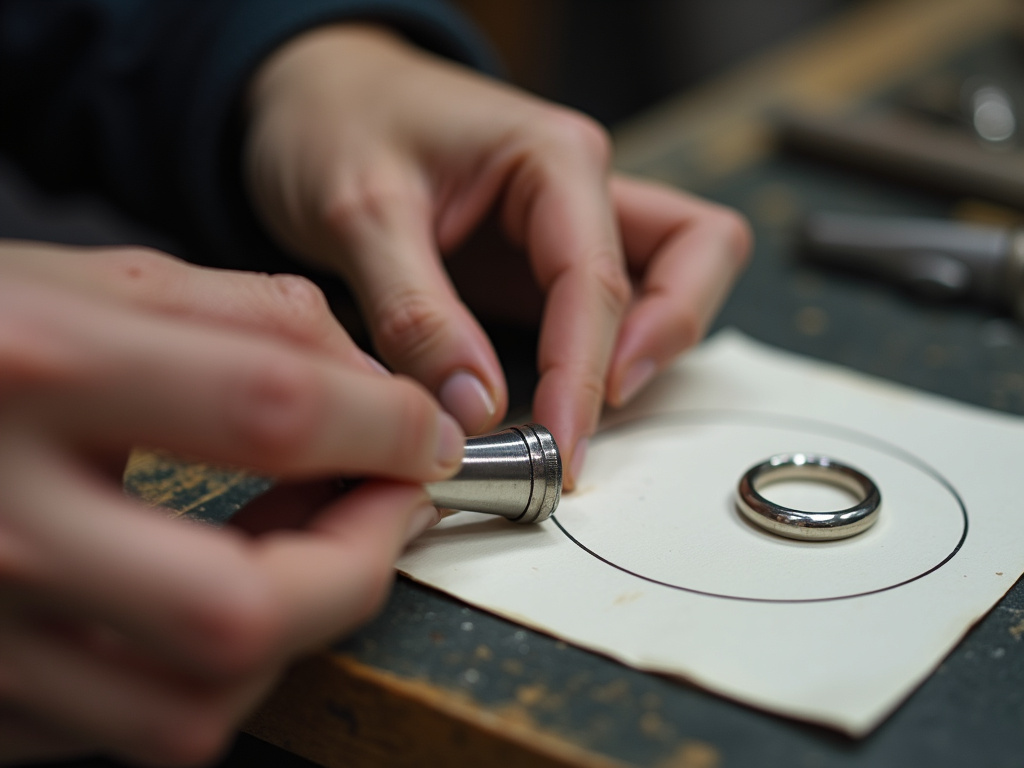
You have a measurement, a traced circle or a number in millimeters. Now you need to convert that data into a guaranteed size. This is the step amateurs skip and professionals never do. Walk into a local jeweler with your evidence.
If you have the borrowed ring, this is simple. Ask them to size it on a ring mandrel, the tapered metal tool marked with sizes. They’ll tell you the exact US size in under a minute. If you only have a paper tracing, bring that. A good jeweler can place the mandrel over the circle and read the corresponding size. This verification costs nothing and builds a relationship for the eventual purchase or a professional ring appraisal.
Ask three specific questions when you verify:
1. “What is the exact size in US standard?”
2. “Based on this size and a [wide/comfort-fit] band, would you recommend a quarter size adjustment?”
3. “Is the ring style I’m considering easily resizable?”
This last question is critical. For complex settings that can’t be resized, your secret measurement must be perfect, and insuring valuable jewelry becomes even more important since alteration isn’t an option. After you have the perfect fit, you’ll want to know the best methods for cleaning a diamond ring to keep it sparkling.
What If You Have No Ring and No Physical Access?
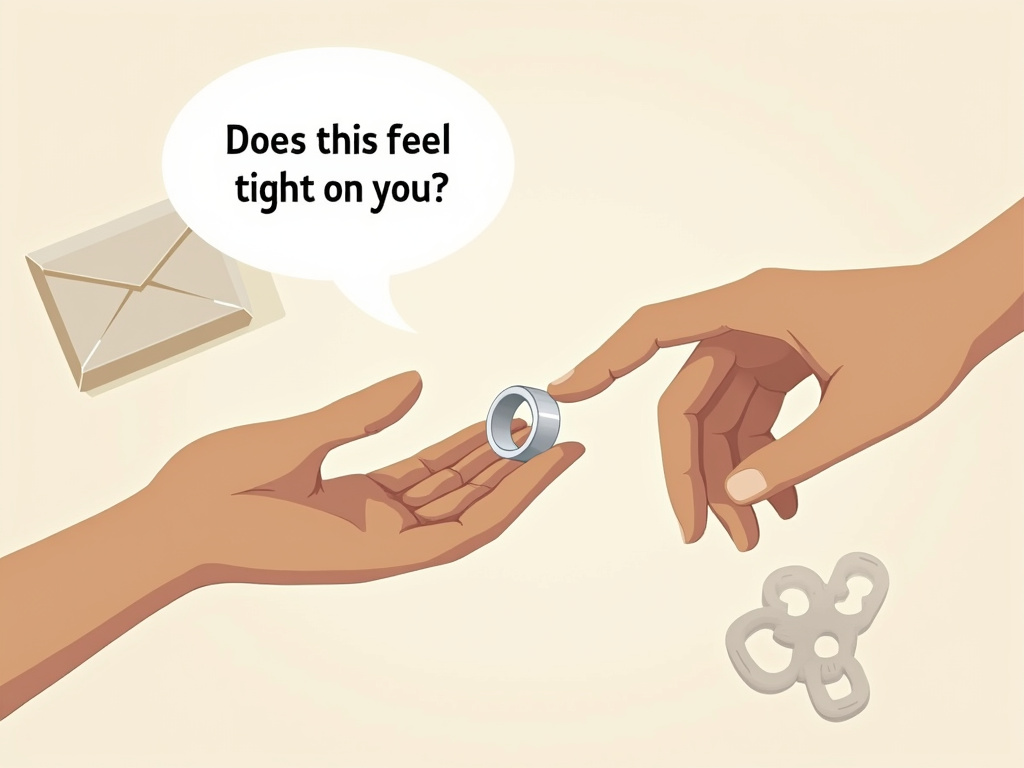
This is the hardest scenario: long-distance relationships, or someone who simply doesn’t wear rings. You must become a detective and use social engineering.
Enlist a trusted ally. A best friend, a sibling, a parent. Their mission is to get the target to try on a ring in a non-suspicious context. “My hands are so swollen today, does this ring feel tight on you?” or “I’m cleaning my jewelry, does this look dull on my hand or yours?” The ally then takes that ring for measurement. This method works because it uses a real ring on the real finger, even if briefly.
The “print-at-home” sizer is a last-resort tool. Companies like Blue Nile offer free plastic sizers, while James Allen requires a deposit. You can mail one to your ally with instructions. The key is to have the target try it on at room temperature, in the late afternoon. The ally must ensure the sizer slides over the knuckle snugly but comfortably.
| Method | Accuracy | Best Tool | Ideal For |
|---|---|---|---|
| Borrow & Trace | High | Rhodia paper, Palomino pencil, metal ruler | Anyone who wears rings regularly |
| Ally Social Engineering | Medium-High | Ally’s own ring | Long-distance, ringless partners |
| Print-at-Home Sizer | Medium | Plastic sizer (e.g., Stuller RSK-1) | When an ally can’t borrow a ring |
| Direct Finger Measure | Low | Non-stretch dental floss | Absolute last resort only |
Common mistake: Guessing based on shoe size or height, this is a complete myth with no correlation. It guarantees an ill-fitting ring.
If you are completely stuck, consider a proposal with a temporary placeholder ring or a necklace, followed by a joint ring-shopping trip. It’s less cinematic, but it guarantees a perfect fit. This approach also lets you discuss tarnish-resistant jewelry options for their lifestyle and explore Pandora ring care if that’s their preferred style.
Frequently Asked Questions
Can a jeweler determine ring size from a photo?
No, not accurately. A jeweler needs a physical reference, a borrowed ring, a precise tracing, or the actual finger. Photos distort perspective and scale, making any guess unreliable.
How much does it cost to resize a ring if I get it wrong?
For a standard gold, silver, or platinum band, resizing 1-2 sizes typically costs between $30 and $80. However, resizing is not always possible. Full eternity bands, tension settings, and rings with intricate channel settings often cannot be resized without compromising the structure or stones.
Is it better to guess a size slightly too big or too small?
It is always better to guess slightly too big. A ring that is a half size too large can be fitted with small, removable sizing beads or a temporary plastic sizer inside the band. A ring that is too small cannot be worn at all until it is stretched, which is a more complex and expensive alteration.
Do fingers change size over time?
Yes. Weight fluctuation, pregnancy, arthritis, and even permanent swelling from conditions like edema can change finger size. This is why many jewelers recommend ring insurance options that may cover periodic resizing. It’s also a good argument for choosing a resizable setting for a lifelong ring.
Can I use a piece of string while they’re asleep?
You can, but it’s risky. String stretches, and the act of wrapping it can wake them. If you must, use non-stretch dental floss and measure at the base of the finger, not the knuckle. Add a full half size to the chart result to account for cold, sleeping fingers.
Before You Go
Secretly getting a ring size is a mix of theft, science, and verification. Steal the size from an existing ring whenever possible, it’s the only method that respects the knuckle. Adjust that number for the warmth of the day and the width of the new band. Then, take your evidence to a jeweler for a final, professional read.
The perfect surprise isn’t just about the moment of revelation. It’s about the ring sliding on smoothly and fitting as if it were always there. Do the detective work upfront. Your reward is the look on their face when it fits perfectly, with no follow-up questions or trips to the jeweler needed.
After that, all that’s left is to learn the best ways of silver ring maintenance and proper jewelry storage to keep that perfect piece shining and safe for years to come. With the right care, that first perfect fit is just the beginning of its story.
