
Can You Finance an Engagement Ring? Expert Advice & Tips
Yes, you can finance an engagement ring through several methods, including 0% APR credit cards, personal loans, jewelry store plans, and Buy Now, Pay Later services. The national average cost sits around $5,200, making financing a practical step for many. Your credit score, the ring’s price, and your repayment discipline will determine which path is financially sound, and which could trap you in costly interest.
I remember the first time a client showed me her jewelry store financing statement, her hands trembling. She’d missed a single payment deadline on what she thought was a 0% deal. The retroactive interest charge was more than my rent that month. At TheJewelryNook, I’ve learned that financing a ring isn’t about the monthly payment; it’s about understanding the contract’s silent countdown clock.
Let’s navigate this together, not with generic advice, but with the specific numbers, brand-name options, and personal lessons from helping couples make this pivotal purchase.
Key Takeaways
- A true 0% APR credit card from a major issuer like Chase or American Express is the optimal route only if your credit score is in the mid-600s or higher and you can absolutely pay the balance within the 12- to 21-month promotional window.
- The average engagement ring costs $5,200, but regional variation is stark, it’s nearly $6,900 in the Northeast, while Midwestern states average $4,900.
- Jewelry store “special financing” almost always uses deferred interest, a dangerous clause where missing the payoff deadline triggers interest charges retroactive to the purchase date.
- A personal loan from a lender like SoFi or Discover offers predictable, fixed payments over 2–7 years, with current rates from 7% to 36% APR based largely on your credit.
- Financing a ring can temporarily lower your credit score, primarily by spiking your credit utilization ratio if the purchase exceeds 30% of your total available credit.
What Does “0% Financing” Really Mean?
The phrase “0% financing” is a magnet for hopeful buyers, but it hides two fundamentally different mechanisms. Your financial safety depends on knowing which one you’re signing.
A true 0% introductory APR credit card charges no interest on purchases during the promotional period, typically 12 to 21 months. If you have a balance remaining when the promo ends, interest simply begins accruing on that remaining amount from that day forward. Cards like the Chase Freedom Flex or the Citi Diamond Preferred are common examples.
A true 0% APR credit card charges interest only on the remaining balance after the promotional period concludes. A deferred interest plan, prevalent in retail jewelry financing, accrues interest from the purchase date and charges the entire accumulated sum if the balance is not paid in full by the promotional deadline.
Deferred interest is the predator in sheep’s clothing. It’s the standard model for most jewelry store credit cards. The lender calculates interest at a high APR (often 29.99%) from day one but agrees to waive it if, and only if, you pay every single cent before the promotional period ends. Leave $1 unpaid, and you owe all the interest that would have accrued on the original balance.
Before you start: Deferred interest clauses pose a severe financial hazard. The consequence of missing the payoff deadline by even a day is a lump-sum interest charge often totaling thousands of dollars, retroactively applied. Mitigation requires setting a payment schedule that clears the balance at least one month early and confirming payoff in writing.
TL;DR: Always verify whether a “0%” offer is a true introductory APR or a deferred interest plan. The latter requires flawless payoff discipline.
How Will This Ring Purchase Affect My Credit Score?
Applying for financing triggers a hard inquiry, which may ding your score by a few points for a short time. The more significant impact comes from your credit utilization, the percentage of your total available credit you’re using. This is the second most influential factor in your FICO score.
Charging a $5,200 ring on a card with a $10,000 total limit shoots your utilization to 52%, a red flag for lenders. A spike like this can cause a notable, though not permanent, score drop. The score recovers as you pay down the balance.
| Credit Scenario | Total Credit Limit | Ring Charge | Utilization Rate | Score Impact |
|---|---|---|---|---|
| Strong Position | $20,000 | $5,200 | 26% | Minimal |
| Risk Zone | $10,000 | $5,200 | 52% | Likely Decrease |
| Danger Zone | $6,000 | $5,200 | 87% | Significant Decrease |
Common mistake: Financing a ring on a credit card right before a major loan application, like a mortgage. The resulting utilization spike can lower your credit score enough to qualify you for a higher mortgage rate, potentially costing tens of thousands over the loan’s life.
If you’re planning other big financial moves, consider a personal loan. Because it’s an installment loan, the amount doesn’t factor into your revolving credit utilization ratio the same way a maxed-out credit card does.
Is a Personal Loan a Safer Choice?
A personal loan feels clinical, in a good way. You receive a lump sum deposited directly into your bank account. You then buy the ring outright, like a cash purchaser. Every month, one predictable autopay hits. There’s no promotional countdown clock ticking in your head. For something as emotionally charged as an engagement ring, boring can be beautiful.
Lenders such as SoFi and Discover market personal loans for wedding expenses. Current APRs range from about 7% for excellent credit to 36% for poor credit. The Federal Reserve reports the average rate for a two-year personal loan is 11.57%. Terms typically span 24 to 84 months, and loan amounts can go as high as $100,000.
| Financing Type | Ideal Credit | Key Advantage | Primary Risk |
|---|---|---|---|
| 0% APR Credit Card | Excellent (720+) | Pay zero interest | Deferred interest traps, high post-promo APR |
| Personal Loan | Good to Excellent (670+) | Predictable, fixed payments | Higher total interest cost over long terms |
| Jewelry Store Financing | Fair to Good (580+) | Long promotional periods | Pervasive deferred interest clauses |
| BNPL (Interest-Free) | Any (soft check) | Simple, short-term | Very short repayment window (e.g., 6 weeks) |
The clean separation between the loan and the purchase is a major benefit. It also means you should secure a professional ring appraisal for your records, as it documents the asset’s value for both you and your insurer.
Can You Trust Jewelry Store Financing?
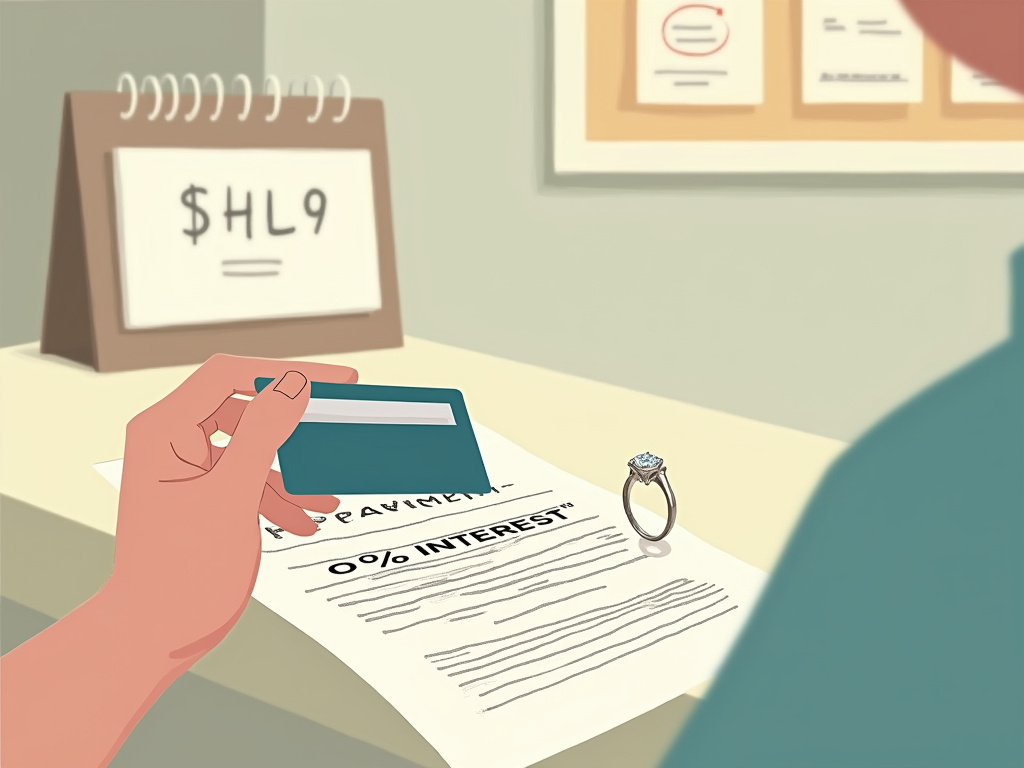
Walk into a major jewelry retailer, and the promise of “special financing” is part of the sales script. The convenience is seductive, apply once, get approved, and drive home with the ring. This is also where I’ve witnessed the most financial heartbreak in my business.
In my first year running TheJewelryNook, I consulted for a client who financed a beautiful Tacori setting through a store plan. She showed me her statement 23 months into a 24-month “0% interest” deal. She’d paid $4,800 of the $5,500 balance. A bank error caused her to miss the final payment date by seven days. The store charged her $1,900 in retroactive interest at 29.99% APR. Her “0%” deal suddenly cost over $7,400. She thought she’d been chipping away at the principal. She hadn’t.
These plans often boast longer promotional periods, up to 36 months, which is their main allure. But the severity of the deferred interest penalty makes them perilous. If you proceed, automate payments for significantly more than the minimum and mark the payoff date in multiple calendars. Once the ring is yours, transferring that diligence to insuring your engagement ring is the logical next step.
When Does Buy Now, Pay Later Make Sense?
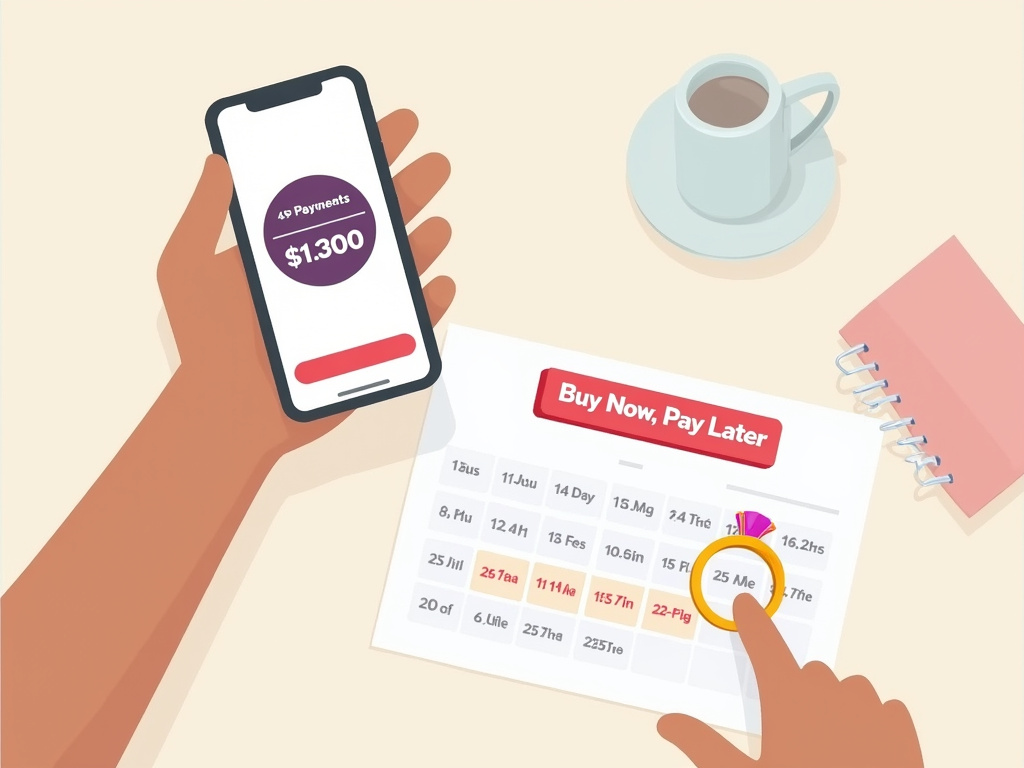
Services like Affirm, Klarna, and Afterpay have made inroads with jewelers. Their classic model splits a purchase into four equal, interest-free installments over six weeks.
This is a sensible tool for a modest ring, perhaps under $1,000. It smooths cash flow without a hard credit check. But the math breaks down quickly for an average-priced ring. Four payments of $1,300 every two weeks is a severe cash flow hit.
Some providers now offer extended monthly plans spanning years, but these always charge interest, with rates rivaling credit cards. BNPL is a short-term bridge, not a long-term financing solution.
Common mistake: Using a six-week, interest-free BNPL plan for a $5,000 ring. The required bi-weekly payments often become unmanageable, leading to late fees and potential service restrictions, negating the benefit.
If you use BNPL for jewelry, pair it with a commitment to proper jewelry storage from day one, preserving your purchase’s condition and value.
What Financing Options Match My Credit Score?
Your credit score is the key that unlocks specific doors. Here’s how the landscape typically looks:
- Excellent Credit (720+): Honestly, you’re in the driver’s seat. A true 0% APR card. I’m partial to the American Express Blue Cash Everyday for its 15-month intro period, lets you park the cost interest-free. If your discipline is ironclad, this is the play. For everyone else, the fixed-rate loan might be safer.
- Good Credit (670-719): You’ll likely qualify for solid personal loan rates and some 0% cards, but maybe not the longest terms. This is the zone where you must shop. Compare a SoFi wedding loan at maybe 9% APR against a card’s 18-month 0% window. The loan’s predictability often wins for peace of mind.
- Fair Credit (580-669): Options narrow. You might not get the best 0% cards. A personal loan is possible (Upstart is known for considering factors beyond credit score), but rates can approach 24%+. Jewelry store financing might approve you, but you must read the deferred interest terms like your financial life depends on it, because it does.
- Poor Credit (Below 580): Traditional financing becomes difficult and expensive. You might only qualify for high-interest store plans. At this point, consider saving longer, exploring alternative stones, or choosing a tarnish-resistant jewelry metal like platinum or palladium to reduce long-term maintenance costs while you save.
Before applying, pull your free reports from AnnualCreditReport.com. Knowing your exact score prevents unpleasant surprises at the application stage.
A Smart Borrower’s Action Plan
- Budget with pre-approval. Know your exact budget by getting pre-approved for a loan or credit line before you fall in love with a ring. This prevents emotional overspending and can give you negotiating power in the store.
- Decode the contract terminology. Scan the financing agreement for “deferred interest,” “no interest if paid in full,” or “promotional financing.” If you see them, assume it’s a deferred interest plan and proceed with extreme caution or choose another option.
- Calculate your mandatory payment, not the minimum. For a 0% or deferred interest plan, divide the total cost by the number of months in the promo period. That’s your real required monthly payment. For a $5,200 ring on a 12-month plan, pay $450 monthly, not the $150 minimum.
- Set a “final payoff” alert. Mark your calendar for one month before the promotional period ends. Use that month to make a final lump-sum payment and get written confirmation that the balance is zero.
- Protect your investment immediately. Contact your insurer to add the ring to your homeowner’s or renter’s policy with a scheduled “personal articles floater.” Standard renters insurance coverage often has low sub-limits for jewelry, leaving you underinsured.
Following this checklist transforms financing from a risky gamble into a managed tool, aligning your romantic gesture with financial clarity.
Frequently Asked Questions
Does financing an engagement ring hurt your credit?
It can cause a temporary dip. The hard inquiry from a new application has a minor effect. A larger potential impact comes from credit utilization: if the ring purchase uses more than 30% of your total available credit, your score may drop until you pay down the balance.
What credit score is needed to finance a ring?
For the best options (true 0% APR credit cards, low-rate personal loans), a score in the mid-600s or higher is typically needed. Some jewelry store plans may approve applicants with scores in the 580s, but these almost always come with deferred interest terms and higher APRs.
Is a loan or credit card better for an engagement ring?
Mathematically, a 0% APR credit card is superior if you can pay the full balance before the promotional period ends. If you need longer than 12-21 months to repay, a fixed-rate personal loan is safer, as it avoids the risk of catastrophic retroactive interest charges.
How long do you have to pay off a financed ring?
Terms vary widely. 0% APR credit cards offer 12-21 month promotions. Jewelry store financing promotions can last 6-36 months. Personal loans have terms of 2-7 years. Interest-free BNPL plans are usually complete within 6 weeks.
Can you finance a ring with no credit check?
Legitimate lenders will perform a credit check. Some BNPL services use a soft inquiry that doesn’t affect your score, but these are for smaller amounts. Offers touting “no credit check” often come from rent-to-own schemes with exorbitant effective interest rates and should be avoided.
The Bottom Line
Financing an engagement ring is a common step, but it’s a financial decision first and a romantic one second. The single most critical action is reading the terms for “deferred interest.” If those words appear, your plan has a hidden tripwire that can financially detonate if your payoff timing is off by even a day.
Match the tool to your timeline and credit profile. A 0% card is a disciplined sprint. A personal loan is a predictable marathon. Store financing is a minefield requiring bomb-disposal precision. BNPL is a short walk for a light load.
Once you’ve navigated the purchase, shift your focus to preservation. Learning safe diamond cleaning methods and general jewelry cleaning routines will keep your symbol of commitment sparkling for a lifetime, just as careful planning ensured its purchase didn’t burden your future together.
