
Can You Wear Jewelry Through TSA? What to Remove at Security
This post contains affiliate links. As an Amazon Associate, we earn from qualifying purchases.
You can wear jewelry through TSA checkpoints. The official Transportation Security Administration policy states jewelry is allowed in both carry-on and checked bags. The catch is metal. High-metal content pieces or certain body piercings can trigger screening machines, leading to a pat-down or a request to remove the item.
Most people think the metal detector is the only worry. It’s not. The Advanced Imaging Technology body scanners most airports use now are sensitive to any metal anomaly on your body, not just a certain mass. A single thick chain or a cluster of bracelets can flag you.
This guide walks through the official rules, what actually sets off the scanners, and how to decide what to wear versus what to pack. It also covers the permanent jewelry trend and what to do if an officer asks you to remove something.
Key Takeaways
- Metal mass matters more than piece count. A single heavy signet ring is more likely to trigger an alarm than five delicate stacking rings.
- Body scanners detect anomalies, not just metal. An AIT machine flags any dense area, which includes clusters of jewelry or large metal pieces under clothing.
- You can request a private screening. If you’re asked to remove a body piercing or sensitive item, you have the right to do so away from the public line.
- Permanent jewelry usually passes. Soldered bracelets and anklets typically use fine, low-metal-content chains that don’t trigger alarms, but it’s ultimately at the officer’s discretion.
- Always carry valuables on you. The TSA explicitly advises keeping expensive or sentimental jewelry in your carry-on bag, not checked luggage.
The Official TSA Stance on Jewelry
The TSA’s rules are publicly available, but they live in the nuance. Their official TSA jewelry policy page is clear: jewelry is permitted. They recommend keeping valuable items in your carry-on and offer private screening for valuables. The final decision, however, rests with the officer at your checkpoint. An item can be denied if it triggers an alarm, appears tampered with, or raises any security concern.
TSA Jewelry Screening Rules: Jewelry is allowed in carry-on and checked bags. For your safety and that of other passengers, please remove all items from your pockets and avoid wearing clothing, shoes, or jewelry with high metal content to reduce the likelihood of an alarm and pat-down.
That last part is the operational detail most guides miss. “High metal content” isn’t defined by weight or purity. It’s a functional threshold the scanner sets. A officer sees an anomaly on their screen and must resolve it.
TL;DR: The TSA allows jewelry, but the officer can deny anything that alarms the scanner. Their public advice is to avoid high-metal items to prevent a pat-down.
What Actually Triggers the Scanners?
There are two primary screening technologies: the classic walk-through metal detector and the Advanced Imaging Technology body scanner. Your experience hinges on which one you get.
Metal detectors work on mass and conductivity. A small gold stud earring usually passes. A large metal belt buckle or a chunky steel bracelet will almost certainly sound the alarm. The machine is looking for a specific magnetic signature.
The AIT scanner is different. It creates a generic outline of your body and highlights areas where there’s a density difference from the expected norm. A cluster of rings on one hand, a heavy pendant under your shirt, or a thick anklet can appear as a yellow box on the officer’s screen. That box means “anomaly detected,” and protocol requires them to identify it.
| Scanner Type | How It Detects | Jewelry That Triggers It |
|---|---|---|
| Walk-Through Metal Detector | Electromagnetic field disruption | Large metal items: big belt buckles, chunky bracelets, multiple thick chains. |
| Advanced Imaging Technology (AIT) | Density anomaly mapping | Clusters of metal (stacked rings), dense items under clothes (pendants), asymmetric metal placement (one wrist heavily adorned). |
The pat-down that follows is standard procedure to clear the anomaly. It’s not personal. They’re checking for prohibited items concealed by the jewelry.
Common mistake: Wearing a statement necklace under a sweater — the pendant creates a dense, unexplained mass on the AIT scan. You’ll get a pat-down focused on your chest area, which is more invasive than just taking the necklace off beforehand.
What About Permanent Jewelry?
The soldered bracelet and anklet trend creates a real-world test case. Videos from travelers show a consistent pattern: permanent jewelry usually passes. The chains used are often fine, low-metal-content alloys like 14k gold fill or sterling silver. Their mass is frequently below the scanner’s threshold.
I watched a traveler with three thin, soldered bracelets walk through an AIT scanner without a blink from the officer. The machine didn’t flag the anomaly because the combined metal mass was too diffuse.
But “usually” isn’t “always.” The TSA’s guidance on body piercings applies here by analogy. If the jewelry alarms the scanner, you may be asked to remove it. Since it’s permanent, that would mean cutting it off. In practice, officers will likely perform a pat-down of the area instead. You can request a private screening for this.
If you’re considering permanent jewelry and travel frequently, opt for the thinnest chain possible. Discuss it with the artist. A 1.5mm rope chain is more likely to pass than a 3mm cuban link.
What to Wear vs. What to Pack
This is the core decision. Getting it wrong means extra screening, stress, and potential loss. Use this checklist before you head to the airport.
Wear This (Low-Risk):
- Stud earrings (small posts)
- Simple band rings (plain metal)
- Thin chain necklaces (under 2mm)
- Delicate bracelets (one or two)
- Watches with leather/nylon bands (remove if it’s chunky metal)
Pack This in Your Carry-On (High-Risk):
- Large hoop or dangling earrings
- Statement necklaces with large pendants
- Multiple chunky bracelets or bangles
- Belts with big metal buckles
- Any jewelry with high metal volume you wouldn’t want a stranger handling
The rule of thumb is surface area and density. A wide, flat bangle might have less metal mass than a thick chain, but its larger surface can disrupt a scanner’s field more. When in doubt, pack it.
TL;DR: Thin, simple, and minimal goes on your body. Thick, chunky, or valuable goes in your bag. Your carry-on bag is your control zone.
How to Handle Body Jewelry and Piercings
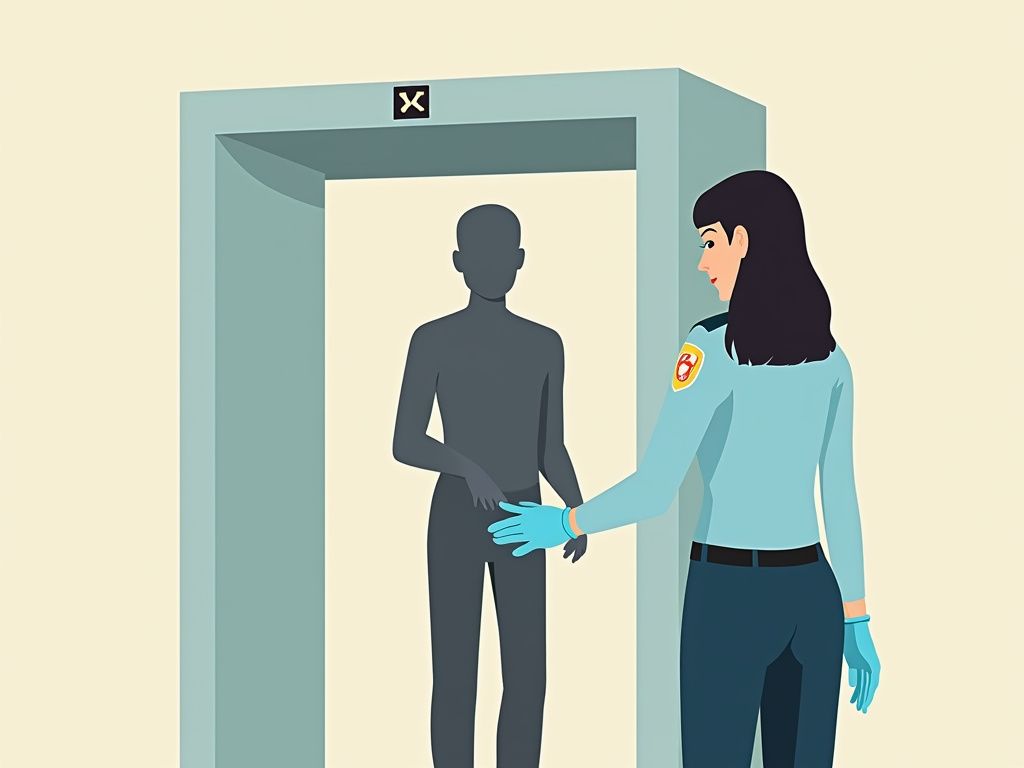
Body jewelry falls into a special category because you often can’t easily remove it. The TSA knows this. Their official stance is that metal body piercings may cause an alarm, which could result in a pat-down. You may be asked to remove the piercing in private as an alternative.
Before you start: If you have sensitive or intimate piercings, know that you have the right to a private screening. Simply tell the officer, “I would like a private screening, please.” They are required to accommodate you.
The process is straightforward but requires you to speak up.
1. Declare it early. When you reach the officer checking IDs and boarding passes, mention you have body piercings that may set off the scanner.
2. Go through the scanner. If you alarm, the officer will direct you to a waiting area.
3. Request privacy. Once the officer informs you of the pat-down, state your request for a private screening. A second officer of the same gender will escort you to a screened-off area.
4. The pat-down happens. The officer will use the back of their hands to pat the area around the piercing. They should not ask you to remove it unless it is clearly accessible and removable (like a navel ring with a standard clasp).
The key is not being surprised. The pat-down is protocol, not punishment.
What If You Set Off the Alarm?

You followed the rules, but a piece you forgot about triggers the scanner. Don’t panic. The procedure is standardized.
First, the officer will ask you to identify what might have caused it. Be honest. “It’s probably my bracelet” is better than silence. They may ask you to remove it and send it through the X-ray on its own. If you can’t remove it (like a tight-fitting ring or permanent piece), they will proceed with a pat-down.
The pat-down is a manual inspection of the flagged area. The officer will use the back of their hands and explain what they are doing. You can request a private screening at any point if you feel uncomfortable. Remember, the goal is to resolve the anomaly on the screen. Cooperating clearly and calmly is the fastest path through.
After the pat-down, if the officer is satisfied, you collect your belongings and go. If the anomaly remains unresolved, they may escalate to a supervisor or ask for additional screening. This is rare for simple jewelry.
Common mistake: Arguing with the officer about the necessity of the pat-down. They are following a mandatory script based on the scanner’s alert. Arguing only slows you and everyone behind you down. State your preference for privacy if needed, then comply.
Protecting Your Jewelry While Traveling
Security checkpoints are one risk. Theft, loss, and damage are others. Your jewelry storage solutions matter just as much as what you wear.
Always use a dedicated, soft-sided jewelry roll or a hard-case organizer with individual compartments. Loose jewelry in a toiletry bag tangles and scratches. For travel jewelry storage, a roll-up case with zippered pockets is ideal. It keeps pieces separate and secure inside your carry-on.
I learned this the hard way after a pair of sterling silver earrings scratched a gold pendant because they were loose in the same pouch. Now nothing travels without its own slot.
Consider tarnish-resistant jewelry for frequent travel. Metals like platinum, titanium, and stainless steel require less maintenance than silver, which can tarnish quickly in humid cabin air. If you must bring silver, include anti-tarnish strips in your case.
Finally, document your valuables. Take clear photos of each piece before you travel. This helps with jewelry insurance claims if the worst happens. Check if your renters insurance covers jewelry while traveling; many policies have sub-limits for items away from the home.
Frequently Asked Questions
Do I have to take off my wedding ring at TSA?
No. Wedding bands and simple rings are generally fine. The officer might ask you to remove it only if it triggers the scanner and they need to clear the alarm. Very wide or thick rings are more likely to cause an issue.
Can I wear a necklace through the scanner?
Yes, but the chain thickness and pendant size matter. A thin chain with a small pendant will likely pass. A thick chain or a large, dense pendant is more likely to trigger a pat-down. When in doubt, put it in your carry-on.
What happens if my body piercing sets off the alarm?
You will undergo a pat-down focused on that area. You have the right to request a private screening for this. The officer should not ask you to remove a piercing that is not easily accessible.
Is it safer to pack all my jewelry?
For valuable or sentimental pieces, yes. The TSA’s comprehensive carry-on guide explicitly advises keeping valuables with you. Checked luggage can be lost, delayed, or rifled through. Your carry-on bag stays under your control.
Before You Go
Wearing jewelry through TSA is about minimizing risk, not eliminating it. Choose simple, low-metal pieces to wear, and pack everything else securely in your carry-on. Remember that body scanners flag anomalies, not just bulk metal. If you do trigger an alarm, stay calm, cooperate, and know your right to a private screening. For the pieces you pack, invest in good jewelry organization to prevent damage. Safe travels.
