
Cross Necklace Disrespect: Navigating Symbolism and Style
Wearing a cross necklace respectfully hinges on three things: your personal intention, the cultural and religious weight of the symbol, and the specific context you’re in. For Christians, it’s a sign of faith; for others, it’s a fashion statement. The friction, and the potential disrespect, arises when those two meanings collide without acknowledgment.
Most people get this wrong because they assume intent is invisible. It isn’t. The way you wear, discuss, and treat the object broadcasts your relationship to it. A sideways cross worn because it’s “edgy” reads differently than a simple pendant worn close to the heart.
This isn’t a simple yes-or-no question. We’ll walk through the biblical arguments, the denominational stances from Catholic to Lutheran, the recent fashion controversies, and the practical situations where your choice might have real consequences.
Key Takeaways
- The core biblical concern is idolatry, worshiping the object itself, not merely wearing it. Exodus 20:4-5 forbids creating an image to worship, not creating any image.
- Major Christian traditions disagree. Catholicism sees reverent use as fine, while The Church of Jesus Christ of Latter-day Saints generally avoids it, focusing on the living Christ.
- Context dictates perception. Wearing a cross in a secular office is different than wearing one as a nurse where it might swing, or in a school with uniform policies.
- Fashion use can cause scandal. The Catholic Church’s Code of Canon Law (No. 1171) warns against the “profane or inappropriate use” of sacred objects, which can include wearing them solely as trendy accessories.
- Your answer matters. If someone asks about your cross, having a truthful response about your intent is the most respectful path forward.
What Does the Bible Say About Wearing a Cross?
The direct scriptural argument against wearing a cross hinges on Exodus 20:4-5: “You shall not make for yourself an idol… You shall not bow down to them or worship them.” Critics point here, claiming the cross is a “graven image.” That’s a surface reading.
The key is the second half of verse 5: “You shall not worship them.” The sin of the Golden Calf wasn’t the sculpture; it was the worship. The prohibition is against creating an object for the purpose of idolatry. A cross necklace worn as a reminder of faith, not as an object of worship, falls outside this command. Many theologians and believers, as highlighted in resources like the GotQuestions religious jewelry FAQ, argue the intent separates veneration from violation.
Common mistake: Citing Exodus 20:4 as a blanket ban on all religious imagery, the text explicitly ties the sin to the act of worshiping the created thing, not its mere existence.
The New Testament offers a different lens. Matthew 5:14-16 calls believers to be “the light of the world,” not to hide their faith. For many, a cross necklace is a quiet, public expression of that light, a conversation starter or a personal anchor. The Evangelical Lutheran Synod FAQ on the symbol emphasizes its use as a “reminder of Christ’s atoning sacrifice,” a tool for remembrance and proclamation, not magic.
TL;DR: The Bible prohibits idolatry, not jewelry. If you’re not praying to the cross, the scriptural objection collapses.
The Line Between Faith and Fashion
The tension exploded into public view in May 2024 when The New York Times called cross necklaces a “hot accessory.” The article treated the symbol primarily as a vogue trend, sparking immediate backlash from faith communities who saw it as reductionist. This wasn’t the first time; the paper had noted a “resurgence” in 2001. Each cycle reignites the same debate: when does a sacred symbol become secular decor?
For the wearer, the line is internal. Are you selecting it from a case of meaningful symbols, or from a display of geometric pendants? The design often tells the story. A minimalist, sleek cross in polished steel reads as modern jewelry. A crucifix with a detailed corpus (the body of Christ) is almost exclusively a religious statement.
A teacher at a parochial school once told a student that wearing a cross sideways as a fashion trend was “bad.” From a Catholic perspective, the Legionaries of Christ explain this could be seen as a “profane or inappropriate use” if the intent is purely fashion, potentially causing scandal by trivializing the sacred.
The fashion industry walks a tightrope. The Inter Faith Network for the UK advises designers to avoid using religious symbols in ways “likely to be offensive to religious believers,” citing a past incident where a shoe company named styles after Hindu deities. The principle extends to jewelry. When a symbol is detached from its meaning for profit, it crosses from appreciation into appropriation.
| Wear Scenario | Primary Perception | Risk of Causing Offense |
|---|---|---|
| Simple cross, worn daily by a self-identified Christian | Personal faith symbol | Low |
| Ornate, jeweled cross as a red-carpet statement piece | High-fashion accessory | Moderate (Seen as secularizing) |
| Sideways or inverted cross worn for “edgy” aesthetic | Counterculture fashion | High (Often associated with sacrilege) |
| Cross worn by non-Christian as appreciation of art/design | Cultural appreciation | Low to Moderate (Depends on context) |
TL;DR: If your primary goal is to complete an outfit, you’re in fashion territory. If it’s to express a belief, you’re in faith territory. Mixing the two requires careful intention.
How Major Christian Traditions View the Practice
Not all Christians agree on this. The spectrum of belief turns largely on how a tradition views religious imagery itself.
Roman Catholicism has a long history of using crucifixes and crosses in worship and personal devotion. The Catechism of the Catholic Church (No. 2284) warns against “scandal,” which includes behavior that leads others to sin or diminishes respect for holy things. This is where the “profane use” idea originates. Wearing a cross irreverently, as mere ornament, could constitute scandal. But wearing it as a sign of devotion is not just accepted; it’s common.
Eastern Orthodox churches also embrace the cross extensively in liturgy and personal piety, often making the sign of the cross during prayer. The iconography is deeply integrated into their spiritual life.
Protestant views vary widely. Many evangelical and non-denominational Christians, referencing the GotQuestions perspective, see no biblical issue if the heart is right. Lutheran theology, as explained by the Evangelical Lutheran Synod FAQ, strongly emphasizes the “theology of the cross” – the concept that God’s power is made perfect in weakness through Christ’s sacrifice. The cross as a symbol points to that theology, making its wearable form a potential tool for witness, not an idol.
The Church of Jesus Christ of Latter-day Saints presents a distinct view. Former President Gordon B. Hinckley explained that “for us, the cross is the symbol of the dying Christ, while our message is a declaration of the living Christ.” This focus on the resurrection makes the cross an uncommon personal symbol for most Latter-day Saints. You won’t find it on their temples, and most members do not wear it.
Common mistake: Assuming all Christian denominations use the cross the same way. The Latter-day Saints’ stance shows a fundamental theological difference that directly informs personal practice.
When Wearing a Cross Might Be Inappropriate or Restricted
Your right to wear a cross bumps into other rights and practical realities. The Inter Faith Network for the UK outlines clear situations where restrictions are legally and socially accepted.
Workplace Dress Codes: An employer can set rules for “corporate identity” or safety. A nurse might be asked to tuck a necklace to prevent it from swinging during procedures. A factory worker might need to remove it around machinery. These rules must be applied equally and not target religious symbols specifically. If a rule bans “all necklaces,” it’s likely enforceable. If it bans “cross necklaces” but allows other pendants, it may be discriminatory.
Security and Identification: At airports, borders, or courts, you may be asked to remove any item that obscures identification. This applies equally to face coverings, large hats, or bulky necklaces that interfere with camera scans.
School Uniform Policies: Many schools have strict uniform codes that prohibit jewelry. While exceptions are often made for religious items, the item usually must be “discreet.” A large, showy cross might not qualify, while a small one on a simple chain might.
Sensitive Social or Professional Settings: In interfaith dialogues or clinical therapy sessions, overt religious symbols can sometimes create an unintended power dynamic or inhibit openness. It’s a matter of professional judgment and situational awareness.
| Context | Potential Restriction | Reasoning |
|---|---|---|
| Healthcare (Surgery, Patient Care) | Must be removed or secured | Infection control, physical safety, patient comfort |
| Industrial / Manual Labor | Must be removed | Risk of catching on machinery (lanyard rules) |
| Courtroom / Government ID | May need temporary removal | Clear facial identification for security cameras |
| Private School with Uniform Code | Must be “discreet” or disallowed | Maintaining uniform standard; policy is usually neutral |
The principle is neutral application. A rule that applies to all necklaces, all facial jewelry, or all headwear is harder to challenge than one that singles out a religious symbol.
How to Wear a Cross Necklace Respectfully
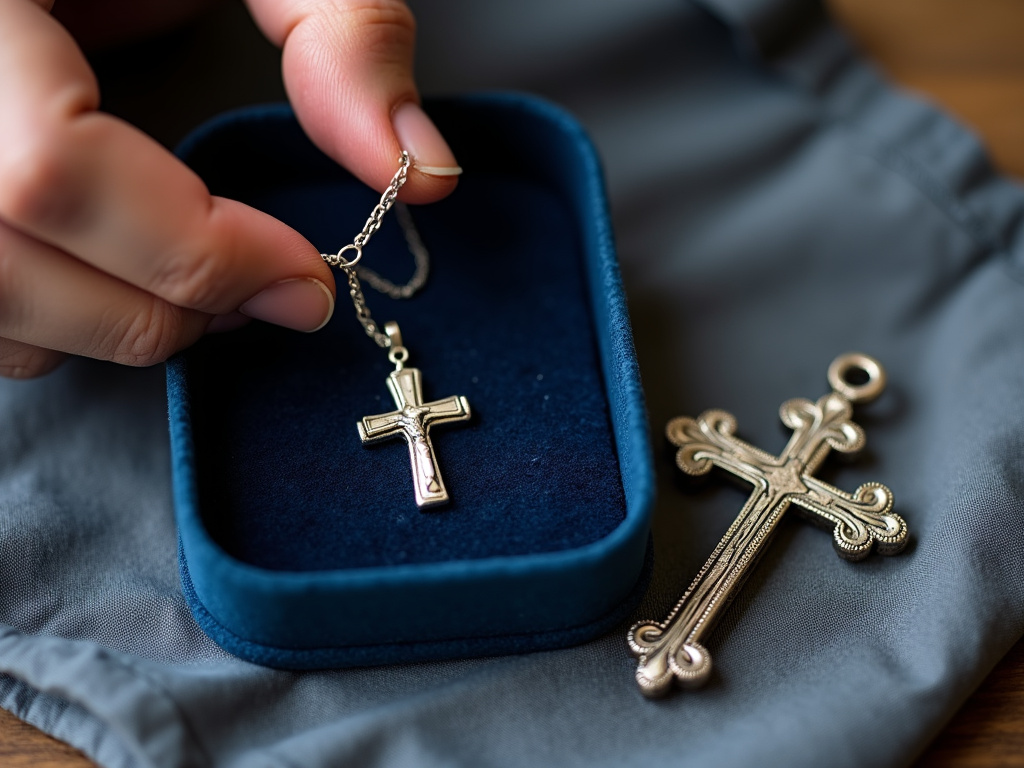
If you choose to wear one, a few guidelines honor both the symbol and the people who hold it sacred.
First, know what you’re wearing. Is it a plain cross or a crucifix? A crucifix depicts the body of Christ and is overwhelmingly a Catholic and Orthodox symbol. Wearing one without understanding its specific meaning can be more jarring to observers than a plain cross.
Second, treat it with care. Don’t toss it in a junk drawer with old keys. Store it thoughtfully, perhaps in a dedicated box or pouch. This isn’t about superstition; it’s about respecting the weight of the symbol you’ve chosen to display. For any fine piece, proper jewelry storage is key to longevity, but for a cross, it also reflects intentionality.
Third, be prepared to answer for it. If someone asks, “Are you religious?” or “What does your cross mean to you?”, have an honest answer. “It’s a reminder of my faith” or “I appreciate it as a symbol of sacrifice” are genuine. “It’s just jewelry” is also an answer, but it may close a conversation or, to a believer, feel dismissive.
Finally, match the piece to your life. A delicate chain with a small cross is appropriate for almost any context. A large, heavy crucifix might be best saved for personal reflection or within your faith community. Consider the metal, too, a tarnish-resistant jewelry option like stainless steel or gold-filled is practical for daily wear.
Cleaning your piece also matters. A tarnished, neglected cross can send an unintended message. Whether it’s cleaning a silver necklace with gentle polish or knowing how to clean gold necklaces without damage, maintaining its appearance shows respect for the object itself.
Frequently Asked Questions
Can non-Christians wear a cross necklace?
Technically, yes. There’s no law against it. Ethically, it’s a question of appropriation versus appreciation. If you wear it without understanding its significance to billions, you risk reducing a central tenet of someone else’s faith to a decoration. If you wear it with knowledge and respect for its meaning, it’s less likely to cause offense.
Is it disrespectful to wear a cross if you’re not religious?
It can be, depending on how you wear it. Wearing it sideways or upside-down for a “goth” or “rebellious” aesthetic directly taps into imagery of sacrilege and anti-Christian sentiment, which many will find deeply offensive. Wearing a tasteful cross as a neutral fashion piece is less charged but may still confuse people about your beliefs.
What’s the difference between a cross and a crucifix?
cross is empty, representing the structure of the execution. A crucifix includes the sculpted body (corpus) of Jesus Christ. The crucifix is specifically a Catholic and Orthodox devotional object emphasizing Christ’s suffering and sacrifice. The empty cross is more common in Protestant traditions, symbolizing the resurrection and empty tomb.
Can my employer force me to remove my cross?
They can if their dress code policy is neutral, generally applicable, and based on a legitimate business need like safety or uniformity. For example, a rule banning all necklaces for safety around equipment is likely enforceable. A rule banning only crosses is not. Knowing your general jewelry cleaning and tarnish prevention tips can help you maintain any piece you wear daily under such policies.
Are there styles of cross necklaces that are less likely to be seen as religious?
Very stylized, abstract, or jewel-encrusted designs are often read as fashion-first. A simple, classic Latin cross (†) is almost universally recognized as a religious symbol. A Celtic cross or Maltese cross also carries specific cultural and historical meanings beyond general Christianity.
The Bottom Line
Wearing a cross necklace sits at the intersection of personal faith, public symbol, and cultural artifact. Disrespect isn’t inherent in the act; it’s baked into the intention and the execution. If you wear it as a sincere expression, handle it with the care you’d give any important gemstone jewelry care requires. If you wear it as fashion, understand the history you’re draping around your neck and be ready for the assumptions people will make.
The most respectful path is the conscious one. Choose the piece, be it a simple stainless steel chain or a classic copper necklace, with intent. Wear it appropriately for your context. And if the question of jewelry turning skin green is your biggest concern, maybe re-examine why you’re wearing it in the first place.
