
Guide to French Style Cuff Links: The Formal Shirt Fastener
A French style cuff link is a decorative fastener used to secure a French cuff, which is a double-length shirt cuff that folds back on itself. Unlike a button, it threads through two or four aligned buttonholes. The cufflink itself consists of two decorative ends connected by a chain, post, or elasticated fabric.
Most people think the formality is in the metal. It’s not. The real formality is in the cuff itself, the double layer of fabric that demands a fastener with some bulk. Choosing the wrong fastener for that fabric is where outfits go from sharp to sloppy.
This guide walks through what defines a French cuff and its companion link, from the classic silk knot to modern metal designs. You’ll learn how to wear them, when to break the old rules, and how to keep your collection in perfect shape.
Key Takeaways
- A French cuff is a double-length cuff that must be folded and fastened with a cufflink or silk knot; it’s the cuff that defines the formality, not the fastener’s material.
- “Kissing” cuffs (where the inside edges touch) are the US standard, while the “barrel” style (with a gap) has a distinct 19th-century history.
- Silk knots, popularized by Paris shirtmaker Charvet around 1904, were originally silk-wrapped but are now often made from other fabrics or designed to look like fabric in metal.
- Modern style allows French cuffs without a jacket or tie, a significant shift from traditional formalwear etiquette.
- Proper storage in a dedicated box or roll is non-negotiable for preventing scratches and tangles, a cornerstone of proper jewelry storage.
The French Cuff Link Defined
A French cuff link doesn’t work alone. Its entire purpose is to fasten a specific shirt sleeve design: the French cuff, also known as a double cuff. This cuff is cut twice as long as a standard barrel cuff. You fold it back on itself, creating a layered, substantial look at the wrist. The folded cuff presents two or four buttonholes that must be pinned together. A standard shirt button is too flimsy for this job.
That’s where the cufflink enters. It’s a stiff fastener that passes through those aligned holes. The simplest definition from any formal shirt accessory documentation is a decorative fastener for a double cuff. The formality comes from the structure of the cuff fabric. The link is the functional jewel that completes it.
A cufflink is a fastener worn by men and women to secure the two sides of the cuff on a dress shirt, blouse, or other garment. French cuff links are specifically designed for use with double cuffs, which are folded back and fastened with these links instead of buttons.
Wearing one signals attention to detail. The cuff adds weight and presence to a sleeve. It demands a complementary accessory with enough visual weight to balance it. A thin, cheap link looks lost. A properly chosen one integrates with the cuff’s fabric and the wearer’s other metals.
TL;DR: The French cuff link is the necessary fastener for a double-length shirt cuff; the cuff’s structure creates the formality, and the link must have enough substance to match it.
Anatomy of a Cufflink: More Than a Fancy Button
Every cufflink has two main parts: the face and the fastener. The face is the decorative front, the part the world sees. It can be a simple metal disc, an engraved crest, a gemstone, or a silk knot. The fastener is the mechanism on the back that holds it through the fabric.
There are three common fastener types. The chain link has two decorative faces connected by a short, flexible chain. You push one face through the holes, flip the chain, and insert the other face back through. The fixed backing, or “bullet back,” has a stationary post on one face and a small, swiveling bar that flips to secure it. The whaleback clasp has a solid, curved metal piece that springs closed.
The post length matters. French cuff fabric is often thick, especially on high-quality cotton or linen shirts. A post that’s too short won’t penetrate both layers of a folded cuff. You’ll struggle to secure the backing. A post that’s too long pinches the fabric awkwardly or feels loose. The ideal post is just long enough to pass through the material and allow the fastener to close without gaping.
This is where cheap cufflinks fail. Their posts are often poorly sized or made from soft metal that bends. The fastener mechanism feels flimsy. Investing in a pair with a solid, correctly proportioned construction makes the daily act of fastening feel precise, not fiddly. It’s a small tactile detail that separates costume jewelry from an heirloom accessory.
The Two Main Types of Cufflinks
The world of cufflinks splits into two broad categories: the soft, flexible silk knot and the rigid, structured metal link. Each serves a different mood and formality level.
Silk knot cufflinks are the original casual option. The Paris shirtmaker Charvet introduced them in 1904, and by 1908, American newspapers noted their rising style. They consist of a decorative knot of fabric, originally silk, now often cotton or polyester, over an elasticated core. This elastic core is the fastener; you simply push it through the buttonholes. The knot gives a pop of color and texture. They’re lightweight, comfortable, and impossible to lose down a drain.
Modern “silk” knots aren’t always silk. Many are made from other fabrics for durability and cost. You can also find metal cufflinks designed to look like fabric knots. These are for the person who wants the visual effect without any worry about the fabric fraying. For real silk knots, gentle hand-washing is key, which aligns with general jewelry cleaning principles for non-metal items.
Metal cufflinks encompass everything else. This includes:
* Fixed-back designs: Like the classic chain link or bullet back.
* Studs or buttons: A single decorative face with a fixed post.
* Novelty links: Shaped like animals, symbols, or miniature objects.
Their maintenance is different. Metals tarnish. Storing them properly in an anti-tarnish cloth or box is a specific part of preventing tarnish on dress accessories. A regular silver care guide or gold polish techniques will keep them bright.
| Type | Best For | Formality | Key Maintenance |
|---|---|---|---|
| Silk Knot | Business casual, colorful expression, comfort | Low to Medium | Spot clean fabric; avoid moisture that degrades elastic. |
| Metal Chain Link | Traditional business, formal events, suits | Medium to High | Polish metal; check chain integrity; store separately. |
| Metal Fixed Back | Everyday professional wear, uniform look | Medium | Cleaning stainless steel or other metals; secure toggle mechanism. |
| Novelty / Gemstone | Personal style, conversation pieces, black tie | Varies Widely | Gentle vintage cleaning methods for delicate settings. |
A Brief History of the French Cuff and Its Fasteners

French cuffs as we know them evolved from the ruffled and lace cuffs of the 17th and 18th centuries. As men’s fashion simplified in the 19th century, the need for a neat, secure fastener for plain white cuffs grew. The cufflink developed to meet that need, moving from purely functional strings and ribbons to decorative items.
The “barrel-style” cufflink, where the cuffs do not meet and leave a gap, was oddly popularized by a 19th-century entertainer and clown named Dan Rice. This style is less common today. The preferred modern style, especially in the United States, is the “kissing” cuff, where the interior edges of the folded cuff touch neatly.
Common mistake: Storing cufflinks loose in a drawer, they will scratch each other, chains will tangle, and silk knots will get crushed, requiring restoring jewelry shine or repair.
The 20th century saw the democratization of the French cuff. Once reserved for the wealthy or for formal “lounge suits,” they became a standard offering on dress shirts. The invention of the silk knot by Charvet offered a less expensive, colorful alternative to precious metal links. This history is well-documented in the Wikipedia page for French cuffs, which traces the sleeve style’s evolution.
Your grandfather’s cufflinks likely followed strict rules. Yours don’t have to. Understanding this history isn’t about following archaic etiquette. It’s about knowing why the “kissing” cuff became the standard, it’s cleaner, and why the silk knot exists, it’s accessible. That knowledge lets you mix elements intentionally rather than by accident.
How to Wear French Cuffs Correctly
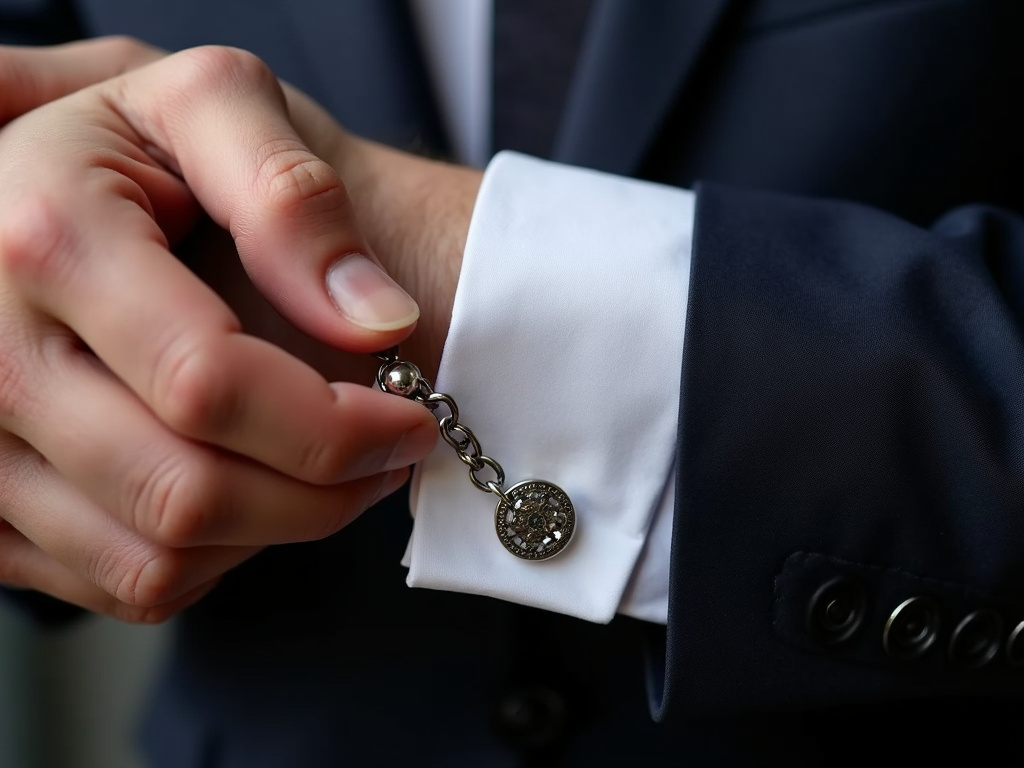
The modern rule is simple: match the link to the cuff’s fabric and the outfit’s formality. A thick, stiff cotton cuff needs a link with a longer post. A delicate silk or linen cuff pairs better with a lighter chain link or a silk knot.
Start with the fold. Fold the double cuff back evenly on itself. The interior lining should be facing out, and the four buttonholes should line up perfectly. If they don’t, the shirt is poorly tailored or you’ve folded it incorrectly. Push the fastener through the two aligned holes on one side. If using a chain link, flip the chain and insert the other end back through the opposite holes. For a fixed back, push the post through and secure the toggle.
The decorative face should sit flat against the outside of the cuff. The cuff should feel snug but not tight around your wrist. There should be no gaping between the cuff and your skin. If there is, the shirt size is wrong.
I used to think a cufflink had to be excruciatingly tight to look neat. I’d force a short post through a thick cuff, straining the fabric. After a season, the buttonholes on my favorite shirt were stretched and frayed. Now I measure. If I can’t fasten it with gentle pressure, I switch to a link with a longer post or a more flexible chain.
What about the old rules? Traditional etiquette reserved French cuffs for formal wear with a jacket, and often a tie. That rule has largely dissolved. You see French cuffs with blazers, with sweaters, and even with no jacket at all. The key is coherence. Wearing a stark white French cuff shirt with jeans and no jacket can look intentionally stylish. Wearing it with a wrinkled t-shirt looks like you got dressed in the dark.
TL;DR: Fold the cuff evenly, choose a link that fits the fabric thickness, fasten it without straining the material, and ignore the old jacket mandate if the rest of your outfit is intentionally polished.
French Cuff Links vs. Other Cuff Styles
French cuffs exist in a spectrum of shirt sleeve finishes. Comparing them highlights why the link is necessary.
The standard barrel cuff is what most dress shirts have. It’s a single layer of fabric fastened with one or two buttons. It’s casual, efficient, and ubiquitous. You cannot use a cufflink on a standard barrel cuff unless it has special buttonholes, which is rare.
Convertible cuffs are a hybrid. They look like a standard barrel cuff but have a second buttonhole, allowing you to fasten them with a button normally or fold them together to use a cufflink. They offer flexibility but often lack the substantial feel of a true double cuff.
The true differentiator is the double cuff’s structure. It’s built for a fastener with presence. A button disappears. A cufflink becomes part of the silhouette. This structural demand is why French cuffs are perceived as more formal, they require a specific, deliberate accessory. It’s an active choice, not a default.
When maintaining these different styles, the needs diverge. A barrel cuff needs basic shirt laundering. A French cuff shirt, especially with attached metal links, often requires more care. You might need to remove the links before washing to protect both the shirt and the jewelry, a specific step in routine jewelry care.
Caring for Your Cufflink Collection
Cufflinks are small, hard, and prone to damage each other. Throwing them in a jewelry box with rings and necklaces is a recipe for scratches and broken chains. Dedicated storage is the first and most important rule of care.
Use a cufflink box with individual compartments or a cufflink roll with soft fabric slots. This keeps metal from rubbing on metal and protects delicate enamel or stone inlays. For organizing jewelry collection pieces like these, compartmentalization is everything.
Cleaning depends on the material. For metal links:
1. Identify the metal. Sterling silver tarnishes fastest and needs regular tarnish removal methods. Gold vermeil (gold-plated silver) requires gentle gold jewelry cleaning to avoid wearing off the plate. Solid gold or platinum is more forgiving.
2. Use the right polish. A soft, lint-free cloth is often enough. For removing tarnish on silver, use a specific silver polish cloth, not toothpaste or harsh chemicals.
3. Mind the mechanics. Avoid getting polish or moisture in the moving parts of a chain or toggle. Dry thoroughly.
For silk knots, avoid submersion. The elastic inside will degrade. Spot clean the fabric knot with a damp cloth and mild soap. Let it air dry completely before storing. If the knot becomes frayed or the elastic fails, they are inexpensive to replace. This is different from the care needed for tarnish-resistant metals like stainless steel, which mainly needs a wipe-down.
| Problem | Likely Cause | Immediate Fix | Long-Term Prevention |
|---|---|---|---|
| Scratched metal face | Rubbing against other jewelry in storage. | Light polish with a jeweler’s cloth. | Store each link in a separate soft compartment. |
| Stiff or stuck toggle | Built-up grime or oxidized metal. | Apply a tiny drop of sewing machine oil, work toggle, wipe clean. | Store in a low-humidity environment as part of long-term jewelry care. |
| Frayed silk knot | Normal wear, snagging, or poor-quality fabric. | Spot clean; consider replacing the pair. | Store flat, not crammed; avoid wearing with rough fabrics. |
| Green skin residue | Reaction with copper in base metal alloys. | Clean link and skin with soap and water. | Upgrade to non-tarnishing jewelry metals like stainless steel, solid gold, or platinum. |
Frequently Asked Questions
Can you wear French cuffs without a jacket?
Yes, absolutely. The old formal rule has faded. A French cuff shirt with a pair of well-fitting trousers or dark jeans can look sharp and intentional. The key is that the shirt itself must be impeccable, crisp, well-ironed, and the right fit. The cufflinks should complement, not overpower, the simplified look.
What is the difference between French cuffs and double cuffs?
There is no difference. “French cuff” and “double cuff” are two names for the same thing: a shirt cuff that is twice as long as a standard cuff and is meant to be folded back and fastened with cufflinks. The terms are used interchangeably.
Are silk knot cufflinks formal?
Silk knots are the least formal type of cufflink. They are traditionally considered appropriate for business casual, daytime events, or when you want a splash of color. They are not suitable for black-tie events or very formal business settings, where metal links are expected. However, a dark, subdued silk knot can bridge the gap.
How many cufflinks should a man own?
Start with three pairs. One pair of simple silver or stainless steel links for versatility. One pair of silk knots in a color like navy or burgundy for business casual. One pair that reflects your personal style, perhaps with a subtle pattern or stone. This covers most occasions. From there, collect based on your wardrobe needs and personal taste, always following jewelry storage best practices.
How do I know if my cufflinks will fit my shirt?
Check the post length. If you have a thick, heavy cotton shirt, a standard short post might not reach. Look for cufflinks marketed as having a “long post” or “king-size” post. For most modern dress shirts, a standard post length is fine. The only way to know for sure is to try fastening them. It should feel secure without excessive force.
The Bottom Line
A French style cuff link is the essential key to a double-cuff shirt. Its job is purely functional, to hold a substantial fold of fabric together, but its execution is where personal style lives. The choice between a quiet silk knot and a bold metal link changes an entire outfit’s tone.
Forget the idea that they’re only for tuxedos. Today’s style is about intentional mixing. Wear them with a blazer, with a sweater, or with a perfectly fitted shirt on its own. Just make sure the link you choose has the right physical proportions for the cuff it’s securing. That’s the difference between looking like you’re wearing a costume and looking like you understand the details.
Store them with care. A scratched cufflink loses its polish, and a tangled chain is a frustration you don’t need. Give them their own space, clean them appropriately for their material, and they’ll be the reliable, sharp accent you reach for every time.
