
Jewelry Word Origin: Tracing Its Historical Etymology Path
The word “jewelry” comes from the Latin “jocale,” meaning “plaything,” which evolved through Old French “jouel” and Middle English “juel” to signify a precious ornament. The modern spelling split, “jewelry” in American English and “jewellery” in British English, reflects its journey across centuries and cultures. The word’s core meaning shifted from a general object of joy to a specific, valuable adornment.
Most people think “jewelry” is just a fancy word for shiny things. They miss the story, a thousand-year journey from a Roman child’s toy to a queen’s crown. The real history is buried in letters, legal documents, and the slow drift of language.
This guide traces that path. We’ll start with the Latin root, follow the word through French courts and English manor houses, and land on the spelling debate you see today. You’ll know exactly why we call it jewelry and what it meant to the people who first used the word.
Key Takeaways
- The root is the Latin “jocale,” meaning a plaything or source of joy, not a gemstone.
- The word entered English as “juel” in the 13th century via Anglo-Norman French (“jouel”).
- The spelling split (jewelry vs. jewellery) solidified in the 18th century, with the double-L form favored in British English.
- Early usage often referred to personal ornaments, but also to treasured objects like books or relics.
- The related French word “bijou” (a jewel) entered English in the 1660s, emphasizing smallness and elegance.
The Latin Root: A “Little Plaything”
The story doesn’t start with gold or gems. It starts with a game.
The ultimate origin of “jewelry” is the Latin word “jocale.” This noun comes from “jocus,” which means “jest” or “game.” So, a jocale was literally a “plaything” or a “thing that causes joy.” This is the core concept that traveled for centuries before it ever touched a precious metal.
The Latin “jocale” (from “jocus,” meaning game or jest) referred broadly to an object of amusement or delight, a meaning that softened and narrowed over centuries into “a precious trinket.”
This origin flips the modern assumption. We associate jewelry with serious value, investment, heirlooms, status. Its ancestor word was about fun. A Roman child’s carved wooden toy and a senator’s signet ring could both be jocale. The meaning was about the emotion the object inspired, not its material worth.
The word made its first major leap as Latin evolved into the Romance languages. In Old French, it became “jouel.” This kept the sense of a “joyful object” but began to specialize. In the courts of medieval France, a jouel was more likely to be a finely made decorative object, a brooch, a ring, a goblet. It was still a source of delight, but the context of aristocracy started to narrow its application.
This is the form that crossed the English Channel. After the Norman Conquest of 1066, Anglo-Norman French became the language of the English court, law, and high society. Words like jouel trickled into the vocabulary of the ruling class. By the time it appeared in Middle English manuscripts in the late 13th century, it was written as “juel.”
| Language Stage | Word | Approx. Time Period | Core Meaning |
|---|---|---|---|
| Classical Latin | jocale | Antiquity | A plaything; an object of amusement or joy. |
| Old French | jouel | Early Medieval Period | A precious object; a trinket or ornament. |
| Middle English | juel | 13th–15th Century | A valuable personal ornament; a gem. |
TL;DR: Jewelry’s origin is the Latin “jocale” (a plaything), which morphed into Old French “jouel” and then Middle English “juel,” slowly narrowing from “any delightful object” to “a precious adornment.”
From ‘Jewel’ to ‘Jewelry’: The Evolution of a Word
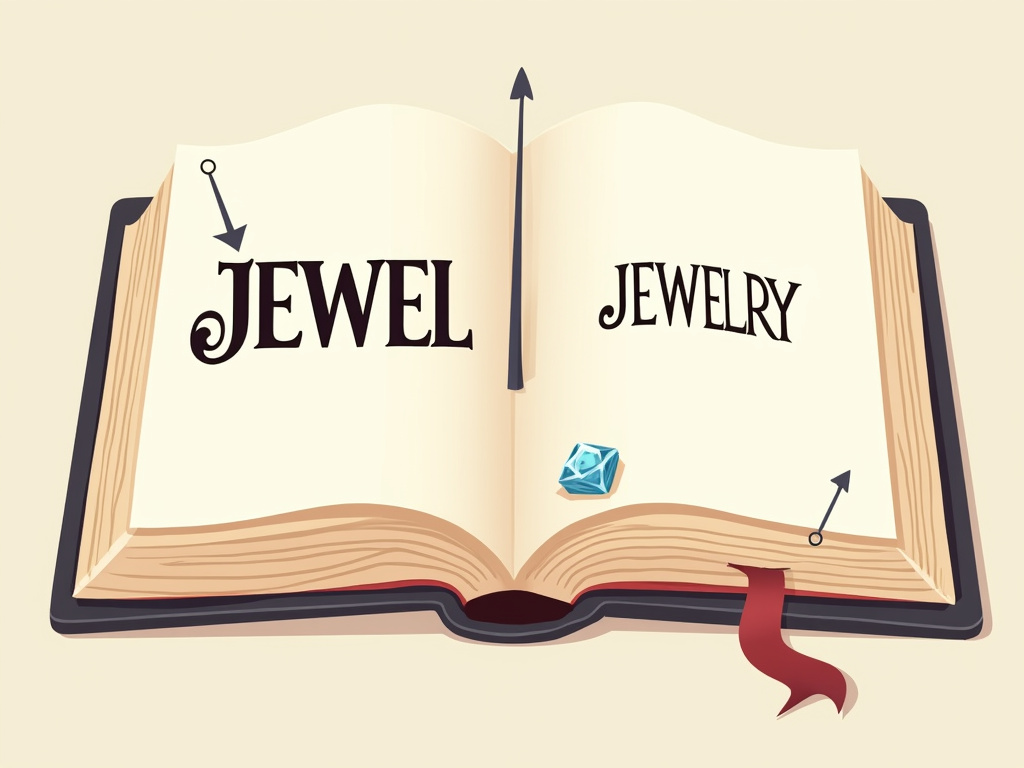
The word “jewel” settled into English, but “jewelry” took a longer, messier path.
For centuries, “jewel” did the heavy lifting. It meant both the individual precious stone or ornament and, collectively, such items. You would speak of “a jewel” on your finger or “the king’s jewel” meaning his collection of regalia. The need for a distinct word meaning “jewels collectively” or “the art of working with jewels” grew as trade and craftsmanship expanded in the late Middle Ages.
The solution was to add a suffix. English borrowed the French suffix “-erie,” which denoted a collection of things or the art/craft related to a noun (think “pottery” from “potter,” “drapery” from “draper”). Sticking “-erie” onto “jewel” gave you “jewelry.” The first recorded use in English pops up in the late 14th century, but it was rare. For a long time, people just used “jewels.”
The word truly cemented its place in the 1700s, the century of catalogues, auctions, and a growing middle class with disposable income for adornment. This is also when the great spelling divide began.
The Great Spelling Split: Jewelry vs. Jewellery
If you’ve ever wondered why Americans write “jewelry” and Brits write “jewellery,” you can blame Samuel Johnson, or rather, the printers who came after him.
In his seminal 1755 A Dictionary of the English Language, Dr. Johnson listed the word as “jewelry.” This reflected a trend to simplify spellings by dropping what were seen as redundant letters. However, across the Atlantic and among more conservative British writers, the older French-influenced spelling “jewellery” (with the double ‘l’) held strong. It simply looked more correct to them, aligning with words like “cookery” or “millinery.”
Common mistake: Assuming “jewelry” is a modern American corruption. It’s actually the older documented form in English dictionaries, while “jewellery” is a reinforced British preference that stuck.
The double-L form won out in Britain and its colonies, while the simplified form became standard in the United States. Neither is “wrong”; they are standard in their respective dialects. This split is a perfect snapshot of how language evolves in different places.
- Jewelry (American English): The simplified, dictionary-standard form since the 18th century.
- Jewellery (British English): The form that retains the French-inspired double ‘l’ and extra ‘e’.
This isn’t just trivia. If you’re searching for vintage jewelry care tips online, knowing both spellings can help you find the best resources. The same goes for understanding gold jewelry maintenance guides from different English-speaking countries.
A Word’s Journey: Dated Proof in Letters and Literature
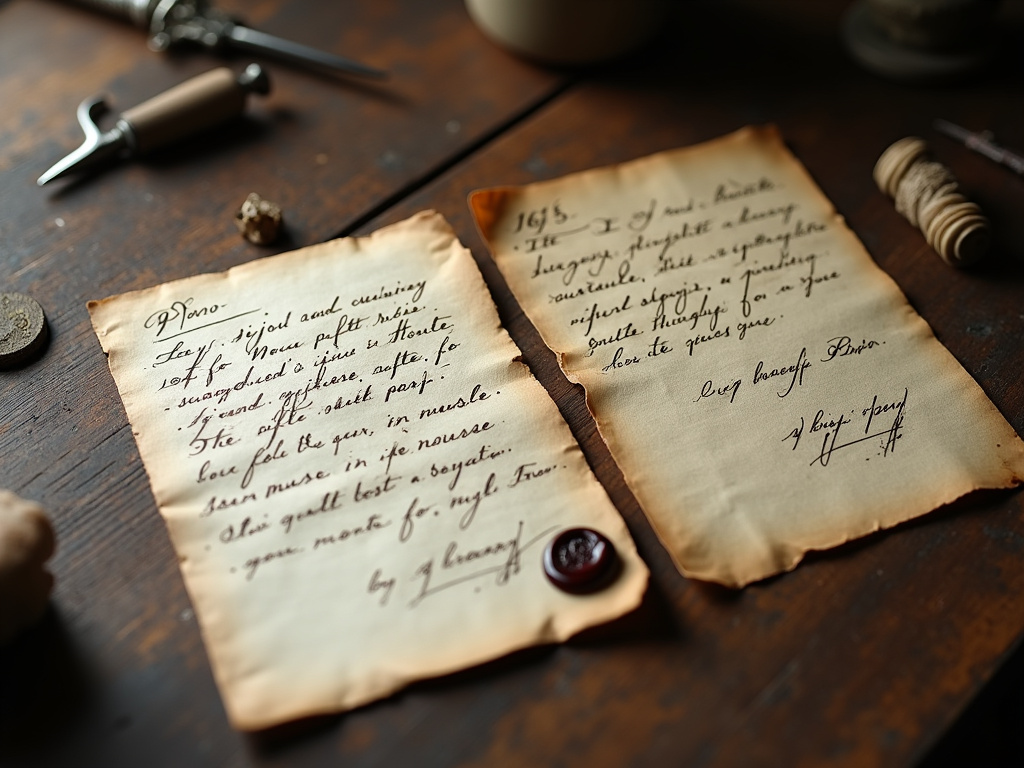
Etymology isn’t guesswork. We know these shifts happened because we can see the words on the page, in letters, wills, and literature. Two specific dated examples show the word in action during its transition.
The first is from 1668. In a letter dated May 4, Lady Chaworth writes to her brother, Lord Roos: “I have sent you a bijou for a seal.” Here, “bijou”, a direct French loanword meaning “a jewel” or “a small elegant thing”, is used in its original sense. It hadn’t yet taken on its broader English meaning of “something small and elegant.” Lady Chaworth was using the fashionable French term in its literal sense, a marker of high-class taste.
The second example, from 1747, shows the meaning shift. Horace Walpole, in a letter to Horace Mann on June 5, describes a house as “a bijou.” He wasn’t calling the house a literal jewel. He was using the word in its new, figurative English sense: something small, elegant, and perfect of its kind. This is the moment the word’s meaning expanded beyond the object itself to describe a quality.
These letters are snapshots. They prove that “bijou” entered English as a noun for a jewel in the 1660s and had evolved into an adjective for “small and elegant” by the mid-1700s. The etymology of the word jewellery follows a similar, documented path from concrete object to abstract concept.
What About “Bijou”?
“Bijou” is jewelry’s linguistic cousin. It entered English from French in the 17th century, but its own origin is murkier. Some linguists trace it back to the Breton word “bizou,” meaning “ring” (from biz, finger). Others suggest a Latin root “bāiulus” (porter, carrier), implying something carried, a trinket.
Regardless of its deepest root, its journey mirrors “jewelry”:
1. Concrete Object: A finger-ring or small jewel (Lady Chaworth’s usage, 1668).
2. Figurative Quality: The characteristic of being small and exquisitely made (Walpole’s usage, 1747).
Today, “bijou” sits alongside “jewelry” in our vocabulary, often used for something delicately beautiful. Its story reminds us that words for precious things often start very literally, on a finger, and grow to describe an idea.
Jewelry vs. Jewellery: A Usage Guide for Writers and Shoppers
Which one should you use? The rule is simple: let your audience decide.
- Use jewelry if you are writing for an American audience, an international brand using US English, or in any context where American spelling is the standard.
- Use jewellery if you are writing for a UK, Australian, Canadian, or other Commonwealth audience.
Getting it “wrong” won’t cause confusion, the meaning is clear, but it can subtly mark your writing as inattentive to your reader’s norms. For online cleaning jewelry tutorials or e-commerce sites, this distinction matters for search visibility and professional presentation.
Here’s a quick reference for when you’re drafting product descriptions or care guides:
| Context | Recommended Spelling | Why |
|---|---|---|
| US-based website or blog | Jewelry | Standard American English. |
| UK/AU/CA-based business | Jewellery | Standard British English. |
| International audience (neutral) | Jewelry | More common globally; simpler spelling. |
| Academic/historical text | Match the source material | If citing 18th-century British texts, “jewellery” may be appropriate. |
TL;DR: Use “jewelry” for American audiences and “jewellery” for British/Commonwealth audiences. Consistency within your document is more important than choosing the “right” one.
The Cultural Weight of a Word
A word’s history shapes how we see the object. Knowing “jewelry” started as a “plaything” reframes it.
It wasn’t initially about bank accounts or mineralogy. It was about human delight. A history and cultural role of jewelry reveals that across civilizations, adornment served ritual, spiritual, and personal joy purposes long before it served as a financial asset. That Latin root, jocale, captures a truth we sometimes forget when discussing karats and appraisals: at its heart, a piece of jewelry is meant to bring joy.
This origin also hints at why we have such personal connections to these objects. They are modern jocalia, playthings for adults, tokens of love, markers of memory. Whether it’s a delicate piece needing silver jewelry care or a sturdy everyday gold jewelry care piece, we care for them because they carry that inherited sense of delight.
I keep my grandmother’s locket in a felt pouch, not a vault. The monetary value is low. But the joy it represents, that’s the original meaning of the word, and it’s the one that still matters when I hold it.
That’s the through-line. From a Roman child’s toy to a medieval lord’s signet ring to the tarnished jewelry in your drawer waiting for a polish, the thread is human pleasure in a tangible form. The word reminds us of that every time we use it.
Frequently Asked Questions
Why are there two spellings: jewelry and jewellery?
The two spellings represent different standardizations of English. “Jewelry” is the American English spelling, simplified in the 18th century. “Jewellery” is the British English spelling, which retained the double ‘l’ from its French-derived suffix “-erie.” Both are correct within their respective dialects.
What is the original meaning of the word “jewel”?
The original meaning comes from the Latin “jocale,” meaning “plaything” or “something that causes joy.” It entered English via Old French “jouel” as “juel,” initially describing any precious object or trinket before narrowing to mean a gem or precious stone.
Is “bijou” related to “jewelry”?
Yes, but indirectly. “Bijou” is a French word borrowed into English in the 1660s, meaning a small jewel or ring. It comes from a different root (possibly Breton bizou for “ring”). It is a synonym, not a direct ancestor, of “jewelry.” Both words converged in English to describe small, precious ornaments.
How old is the word “jewelry” in English?
The word “jewelry,” meaning jewels collectively, first appeared in English in the late 14th century. However, the simpler form “jewel” (from Old French jouel) was used at least a century earlier, appearing in Middle English texts from the late 13th century.
Does the origin change how we should care for jewelry?
Intrinsically, no. Knowing its origin as a “plaything” doesn’t make gold softer. But it reframes the purpose. Whether you’re performing tarnish removal on silver or using a baking soda paste for a gentle clean, you’re maintaining an object designed for joy. That historical perspective can make routine cleaning your jewelry feel more like an act of preservation than a chore.
The Bottom Line
The word “jewelry” carries a thousand years of history in its syllables. It began not in a mine or a vault, but in the Latin concept of play and joy. Its journey through French and into English, its spelling split, and the parallel path of “bijou” show how language evolves with culture. We don’t just inherit the objects from our ancestors; we inherit the very word we use to describe them. The next time you fasten a clasp or polish a band, remember you’re handling a modern jocale, a little thing meant purely for delight. That’s a legacy worth preventing tarnish for.
